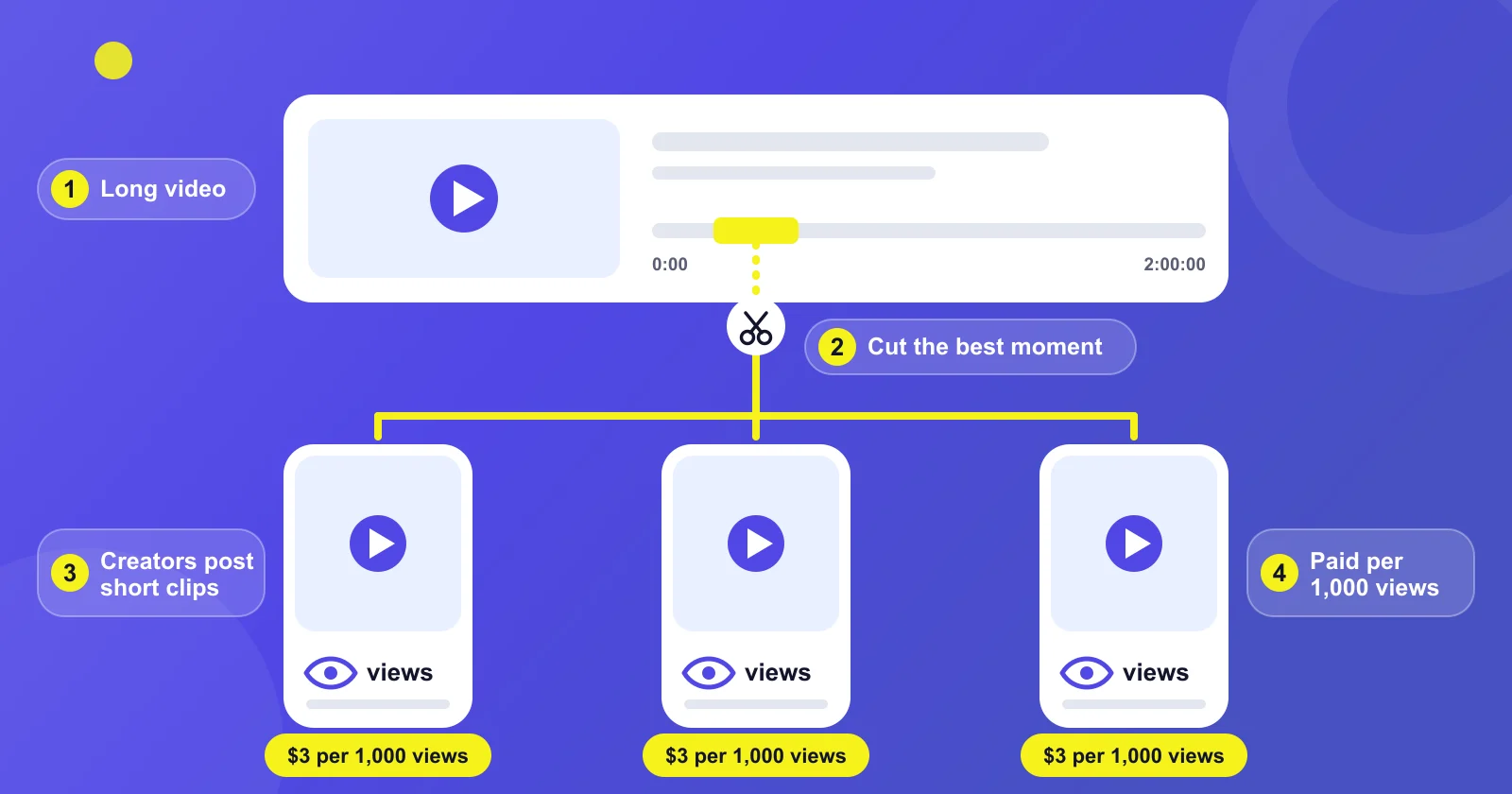
Picture a two hour podcast episode. Forty seconds of it are gold: the founder explains why the product exists, and it lands. Almost nobody saw it, because it sits at minute 83.
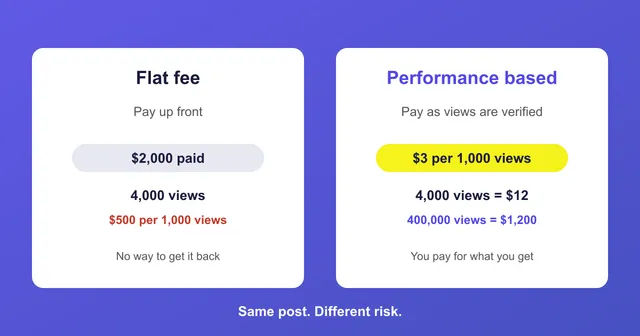
A clipping campaign pays creators to find that moment, cut it into a short vertical video and post it on their own accounts. You pay per 1,000 views. If a clip goes nowhere, you pay nothing for it.
This guide covers how clipping campaigns work, what they cost, where they go wrong and how to run one.
What is a clipping campaign?
A clipping campaign is a paid program where a brand supplies long source footage and independent creators, called clippers, turn it into short clips. Source material is usually a podcast, a stream, an interview or a product demo. Picsart’s overview describes the model as paying creators for views, not for followers.
The clips go out on the clipper’s own account, in front of the clipper’s own audience. That is the point. You are not buying ad space. You are borrowing attention that someone else already built.
How clipping campaigns work, step by step
This is the process Picsart lays out, with the controls you will want at each step.
- You supply footage and a brief. The brief says what the clips should promote, what is off limits, which tags to use and what the payout rate is.
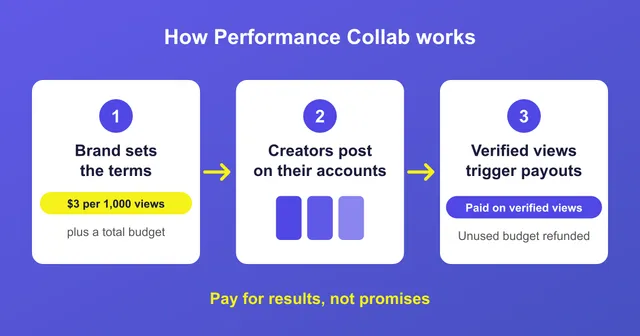
- You set the rate, the budget and a cap. The rate is a CPM, meaning dollars per 1,000 views. The budget is the total you are willing to spend. Many campaigns also cap what one clip or one creator can earn.
- Creators join. In an open campaign they apply on published terms. No pitching and no negotiating post by post.
- They cut and post. Clippers find the strongest moments, trim them to roughly 15 to 60 seconds, add captions and post natively on TikTok, Instagram, YouTube Shorts or X.
- Views are verified and creators are paid. Clippers submit their post links, view counts are checked against platform analytics, and payouts follow per 1,000 verified views.
Why brands run them
- You pay for reach, not promises. No views, no cost.
- Volume. One campaign can produce dozens or hundreds of posts, each with a different hook, which tells you what angle works.
- Distribution you do not have to build. Every clip lands in front of an audience that is not yours yet.
- A clear ceiling on spend. The budget is set before the first clip goes live.
The trade offs are real. You give up some control over each post. Quality varies. And no one can guarantee that a clip will take off. Clipping works best when you already have strong long form content to cut from.
What clipping campaigns cost
Rates vary by campaign and platform. ClipSpeed’s September 2026 guide reports open listings on Vyro at about $1.50 to $2.00 per 1,000 views, and Whop Content Rewards at around $1.00 on average. Picsart notes pay of up to about $5 per 1,000 views, with per clip caps often set near 100,000 views.
Low rates attract high volume, and high volume means uneven quality. If you want creators with real audiences and some taste, we suggest a CPM of $3 to $5. Our guide on how to choose the right CPM shows how to pick a number inside that range.
Here is what a budget buys:
| Budget | CPM | Views you pay for |
|---|---|---|
| $1,000 | $3 | 333,000 |
| $5,000 | $3 | 1,666,000 |
| $10,000 | $5 | 2,000,000 |
A 5% platform fee applies to amounts actually paid out to creators. There is no fee on unused budget.
See what your budget buys
Set a CPM and a total budget, approve your creators, and pay only for verified views.
A real example: $10,000 and 3.3 million views
The Moonshots Gathering was an open campaign, not a clipping campaign in the strict sense, but it runs on the same mechanics: a public brief, a CPM, a budget and a cap per creator. The budget was $10,000, fully spent. The rate was set at $5.00 per 1,000 views, with a $1,500 cap per creator.
3.3M
verified views
215
creators took part
614
approved posts out of 764 submitted
$3.03
actual cost per 1,000 views
The campaign spent its full $10,000 and the blended cost landed 39% under the rate that was set.
Source: Performance Collab, The Moonshots Gathering case study
The posts stay live and keep collecting views after the budget closes. Read the full breakdown in the case study.
The risks, and how to control them
Fake or bought views. Bots and purchased engagement are the biggest threat to any pay per view program. The big marketplaces exclude bot, script and macro views from their counts, according to ClipSpeed. Your own controls are simple: approve who joins, approve each post, cap what one creator can earn and pay only on verified views.
Off brand clips. A clip can be accurate and still be wrong for you. Write a short list of what is not allowed, and review posts before they count toward payouts.
Rights to the footage. Only share what you own or have permission to share. Check guests, music and licensed material before you open the campaign.
Clipping vs UGC vs a flat fee creator deal
Clipping campaign
- Who makes the content
- Creators cut your footage
- Where it is posted
- The creator's own account
- How you pay
- Per 1,000 verified views
- Best for
- Turning long content into reach
UGC campaign
- Who makes the content
- Creators film something new
- Where it is posted
- Often your account or your ads
- How you pay
- Per video, sometimes plus views
- Best for
- New creative and fresh angles
Flat fee deal
- Who makes the content
- One creator, one brief
- Where it is posted
- The creator's own account
- How you pay
- A fixed fee up front
- Best for
- One trusted voice and a launch
You do not have to pick one. Many brands clip first to find what resonates, then pay creators to make new content around it. If you are weighing the payment side, our post on paying creators based on views explains the model.
How to run a clipping campaign on Performance Collab
Clipping campaigns fit an Open Campaign. Here is the flow.
- Publish your brief. Set the budget, the CPM, a cap per creator and what you want made.
- Approve applicants. Creators apply with their profiles. You choose who is in.
- Share your footage with the creators you approve.
- Creators post on TikTok, Instagram, YouTube or X and submit their links. You approve or reject each post.
- Views are verified, and payouts trigger only on verified views. Unused budget comes back to you.
Ready to launch a clipping campaign?
Free to set up. You only pay when creators perform.
A launch checklist
- You own the footage, or have written permission to share it.
- The brief says what to promote, what is off limits and how to disclose.
- The CPM sits inside a range that attracts the creators you want.
- The total budget is a number you are comfortable spending in full.
- A cap per creator is set.
- You know who reviews posts, and how fast.
If you run games, apps or other products with a strong visual story, our guide to creator marketing for games shows the same model applied to one industry. For the bigger picture, read our 2026 guide to performance based influencer marketing, or start with what Performance Collab is.