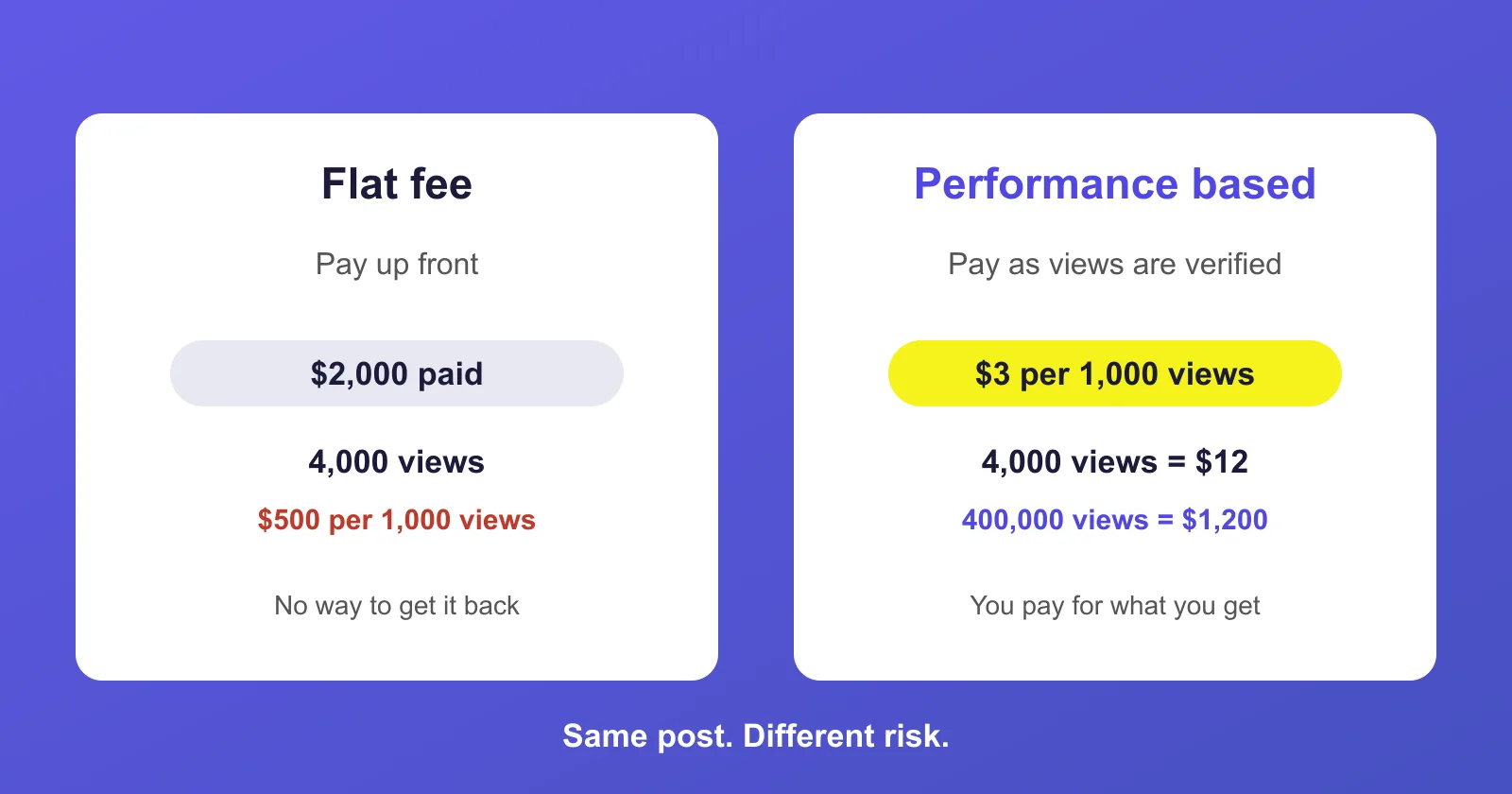
A brand pays a creator $2,000 for a post. The post gets 4,000 views. The brand paid $500 per 1,000 views and has no way to get any of it back.
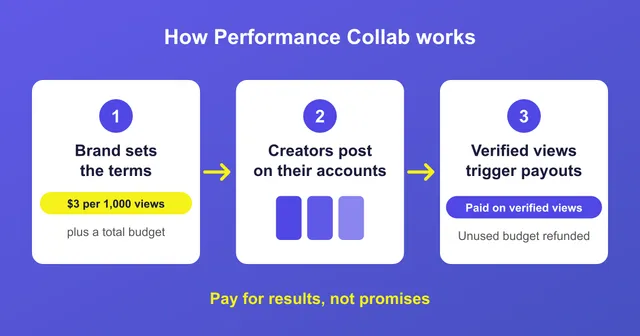
Another brand pays $3 per 1,000 views. The same post gets 4,000 views and costs $12. The next post gets 400,000 views and costs $1,200. Both brands paid for what they received.
That second model is performance based influencer marketing. This guide covers what it is, how the pricing models compare, what it costs, what can go wrong and how to run a campaign.
What is performance based influencer marketing?
Performance based influencer marketing is a way of paying creators where part or all of the payment depends on what the post delivers. The measure can be views, clicks, sign ups or sales. The brand decides the measure and the rate before the campaign starts.
It sits against the older default, the flat fee. A flat fee pays for the work, whatever happens next. Performance pay pays for the outcome.
Interest in creator marketing keeps growing, and so does the money at stake. Influencer Marketing Hub estimates the global industry reached $32.55 billion in 2025, and its 2026 benchmark survey found 87.49% of marketers expected their influencer budgets to rise. Aspire’s 2026 report, based on nearly 900 marketers and creators, puts the share planning bigger budgets at 74%. Both are surveys by companies in the industry, so read them as direction, not precision.
When budgets grow, “what did we get for it?” gets asked more often. Performance pay is one answer.
The ways to pay creators
Flat fee
- You pay for
- The post, up front
- Risk sits with
- The brand
- Best for
- One trusted voice and a launch
- Weakness
- Pay is unrelated to results
Pay per view (CPM)
- You pay for
- Verified views
- Risk sits with
- Shared
- Best for
- Reach, awareness, launches
- Weakness
- Needs view verification
Base plus bonus
- You pay for
- A floor, then views
- Risk sits with
- Shared
- Best for
- Creators you want to keep
- Weakness
- Costs more than pure CPM
A fourth model, commission, pays creators a share of sales or sign ups. It suits products with a clear checkout, but it is slow and hard to attribute, so it rarely fits a campaign built for reach. The three above are the ones most brands compare.
Most brands end up mixing them. Pure pay per view works well when you want reach from many creators at once. Base pay plus a bonus works when you have a smaller group of creators you want to keep.
For a closer look at the flat fee side, see our post on paying creators based on views.
What it costs
In a CPM deal, the maths is simple. Cost equals views divided by 1,000, times the rate.
| Rate (CPM) | 100,000 views | 1,000,000 views |
|---|---|---|
| $3 | $300 | $3,000 |
| $4 | $400 | $4,000 |
| $5 | $500 | $5,000 |
On Performance Collab, a 5% platform fee applies to amounts actually paid out. If a creator earns $500, the fee is $25. There is no monthly fee, and no fee on budget that goes unspent.
What rate should you pick? Too low and you attract volume without quality. Public clipping listings reported in September 2026 paid roughly $1 to $2 per 1,000 views. For creators with real audiences, we suggest $3 to $5. Our post on how to choose the right CPM walks through the decision.
See what your budget buys
Set a rate and a total budget, approve creators and pay only for verified views.
A real example: $10,000, 3.3 million views
The Moonshots Gathering was an Open Campaign: a public brief, one rate for every approved creator, a total budget and a cap per creator. The budget was $10,000 and it was fully spent. The rate was set at $5.00 per 1,000 views, with a $1,500 cap per creator.
3.3M
verified views
215
creators took part
614
approved posts out of 764 submitted
$3.03
actual cost per 1,000 views
The campaign spent its full $10,000 and the blended cost landed 39% under the rate that was set.
Source: Performance Collab, The Moonshots Gathering case study
One campaign is one example, not a promise. But it shows how a capped budget and a set rate keep the spend predictable. Read the whole story in the case study.
How to run a performance based campaign
- Pick one goal. Reach, awareness or a launch? Views are the cleanest measure for all three.
- Set the rate, the budget and a cap. The cap per creator matters. One viral post can otherwise use up a small budget.
- Write the brief. What to make, what is off limits, how to disclose the partnership.
- Choose who posts. Publish the campaign for applications, or invite creators you already trust. Open Campaigns and Direct Campaigns cover the two routes.
- Review every post. Approve what is on brief and reject what is not.
- Pay on verified views. Release payouts only for the views that are verified, and let the rest return to your budget.
What to put in a performance based offer
Creators will ask the same questions, so answer them in the brief before they do.
- The rate. State the dollars per 1,000 verified views, and whether it is rate based or tier based.
- The cap. Say the most one creator can earn, so nobody is surprised.
- The base pay, if any. A guaranteed floor tells a creator their time is respected.
- What counts. Which platforms, which post types and which views are eligible.
- How and when they are paid. Payouts trigger on verified views, so say how verification works.
- The rules. Disclosure, off limits topics and any footage or music restrictions.
A clear offer attracts better creators than a high rate with vague terms. How RPM works shows how to explain the two payout structures in plain numbers.
The risks, and how to control them
Fake or bought views. Any pay per view program attracts people who try to game it. Approve who joins, approve each post, cap what one creator can earn and pay only on verified views.
Off brand posts. A post can hit its numbers and still be wrong for you. Write a short list of what is not allowed and review posts before they count.
Quality swings. When pay follows views, some creators will chase reach over fit. A base pay plus bonus structure, and a short approval step, keep standards up.
No guarantee of virality. Performance pay does not make a post go viral. It makes sure you only pay for what you actually get.
Who benefits
Brands and agencies get predictable cost per view and a hard ceiling on spend. Creators get paid more when their content over performs, and base pay protects them when it does not. That alignment is the point: both sides want content that gets watched.
If you are a game developer, our guide to creator marketing for games applies this model to one industry. For campaigns built on short clips, see how clipping campaigns work.
A launch checklist
- One clear goal for the campaign.
- A rate inside a range that attracts the creators you want.
- A total budget you are comfortable spending in full.
- A cap per creator.
- A brief that says what to make, what to avoid and how to disclose.
- Someone who reviews posts, and a deadline for doing it.
- A plan for what you will do with the results.
Ready to pay for results?
Free to set up. You only pay when creators perform.
New to the platform? Start with what Performance Collab is.